
What a Dry Eye Treatment Plan Actually Looks Like
Patients often arrive expecting a verdict and a bottle. What they get instead, in a specialist practice, is a plan — a sequence of steps, each with a stated purpose, a dose or an interval, and a date at which it will be judged. That structure is not bureaucracy. It is the only honest way to manage a chronic, fluctuating, multi-factorial disease.
Here is what such a plan is actually made of.
It starts with measurement, not treatment
Nothing on the plan can be chosen until the type and severity of your dry eye are known. A structured workup establishes whether the problem is evaporative, aqueous-deficient or mixed; whether the lid margin is diseased; how much functioning gland tissue remains; and how inflamed the surface is.
This matters because the same symptom leads to opposite treatments. Burning eyes with normal tear volume and blocked glands need heat and expression. Burning eyes with a low tear meniscus need volume and conservation. Treating the second like the first wastes months.
Foundation care: the part that never stops
Every plan has a base layer that continues regardless of what else is added. Lid hygiene — cleaning the lid margin daily with an appropriate product rather than whatever is in the shower. Heat, applied properly: a mask or heat pack held for two to five minutes, followed by around thirty seconds of lid massage on each lid, not a flannel that has gone cold in ninety seconds. Deliberate, complete blinking during screen work.
This is the least glamorous part of the plan and the part most often abandoned. It is also the part that determines whether the expensive interventions hold.
In-office procedures and device treatments
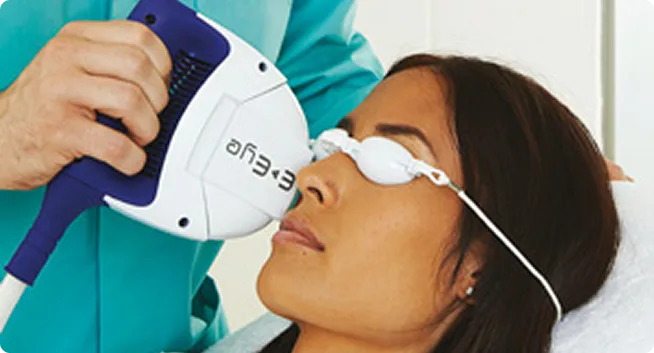
Where the glands are obstructed, inflamed or the lid margin is colonised, the plan adds in-clinic work: debridement, expression and moist-heat therapy, or one of the device treatments — LipiFlow, IPL, Tixel, Rexon-Eye or BlephEx.
These are not interchangeable and they are not a menu to pick from by price. Each targets a different link in the chain, and a good plan states which link. Most are delivered as courses — IPL typically four sessions over twelve weeks, Rexon-Eye four weekly sessions, Tixel around three — with a review at a defined point after the final one.
The lubricant ladder
Drops sit alongside everything else, and the plan should specify not just a product but a frequency and a time of day. A light preservative-free drop several times through the working day. Something heavier — a gel, or an ointment — at night, when blinking stops and the surface is most exposed. Where evaporation is the problem, a lipid-containing or water-free formulation rather than more water.
The detail matters more than patients expect. A drop used twice a day when it needs six is not a failed drop; it is an under-dosed one.
Prescribed medicines, where inflammation demands them
When the inflammatory component is driving the disease, the plan adds prescribed treatment — a short steroid pulse to break a flare, a three-month low-dose doxycycline course or pulsed azithromycin for inflammatory meibomian gland disease, anti-allergy medication where an allergic surface is compounding the problem. These are time-limited and reviewed, not open-ended.
Nutrition
Omega-3 supplementation appears on many plans, and the honest framing is important: it works slowly and modestly. Combinations of omega-3 fatty acids act to reduce lacrimal gland inflammation, supporting tear production and reducing tear film surface tension. They need at least three months to produce a measurable response, both symptomatically and on objective in-office measurements. Anyone judging a supplement at six weeks is judging it too early.
Review: the step that makes it a plan
Every element carries a review point. Steroids are reviewed within weeks. A device course is reviewed at six weeks or six months depending on the treatment. Drops are reviewed anywhere from a fortnight to a year. Oral courses are reviewed at the end of the course.
At review, the same measurements are repeated — tear break-up time, staining, gland expressibility, osmolarity — so that progress is demonstrated in numbers rather than impressions. This is the point of the whole structure. Symptoms in dry eye fluctuate with weather, screen hours, sleep and season; measurements do not flatter you and do not panic you.
The honest expectation
Dry eye disease is chronic, and in many cases it requires ongoing management rather than a cure. That is not a counsel of despair — it is the same relationship you have with blood pressure or skin conditions. What good management delivers is a surface that is comfortable most of the time, glands that stop deteriorating, and a plan you understand well enough to keep running between appointments.
The one thing worth acting on early: gland tissue lost to atrophy does not grow back. Plans made early have more to work with.
Start with an assessment
Dry Eye Specialist Group member practices are independent, optometrist-owned clinics across New Zealand, each running a structured assessment before any treatment is recommended. Find your nearest member practice or see all treatments.
References
- Jones L, Craig JP, Markoulli M, et al. TFOS DEWS III: Management and Therapy. American Journal of Ophthalmology. 2025;279:289-386.
- Craig JP, Nichols KK, Akpek EK, et al. TFOS DEWS II Definition and Classification Report. The Ocular Surface. 2017;15(3):276-283.
- Wolffsohn JS, Craig JP, et al. TFOS DEWS II Diagnostic Methodology Report. The Ocular Surface. 2017;15(3):539-574.
