
Lid Debridement, Gland Expression and Lacrimal Lavage: The In-Office Procedures Behind Dry Eye Care
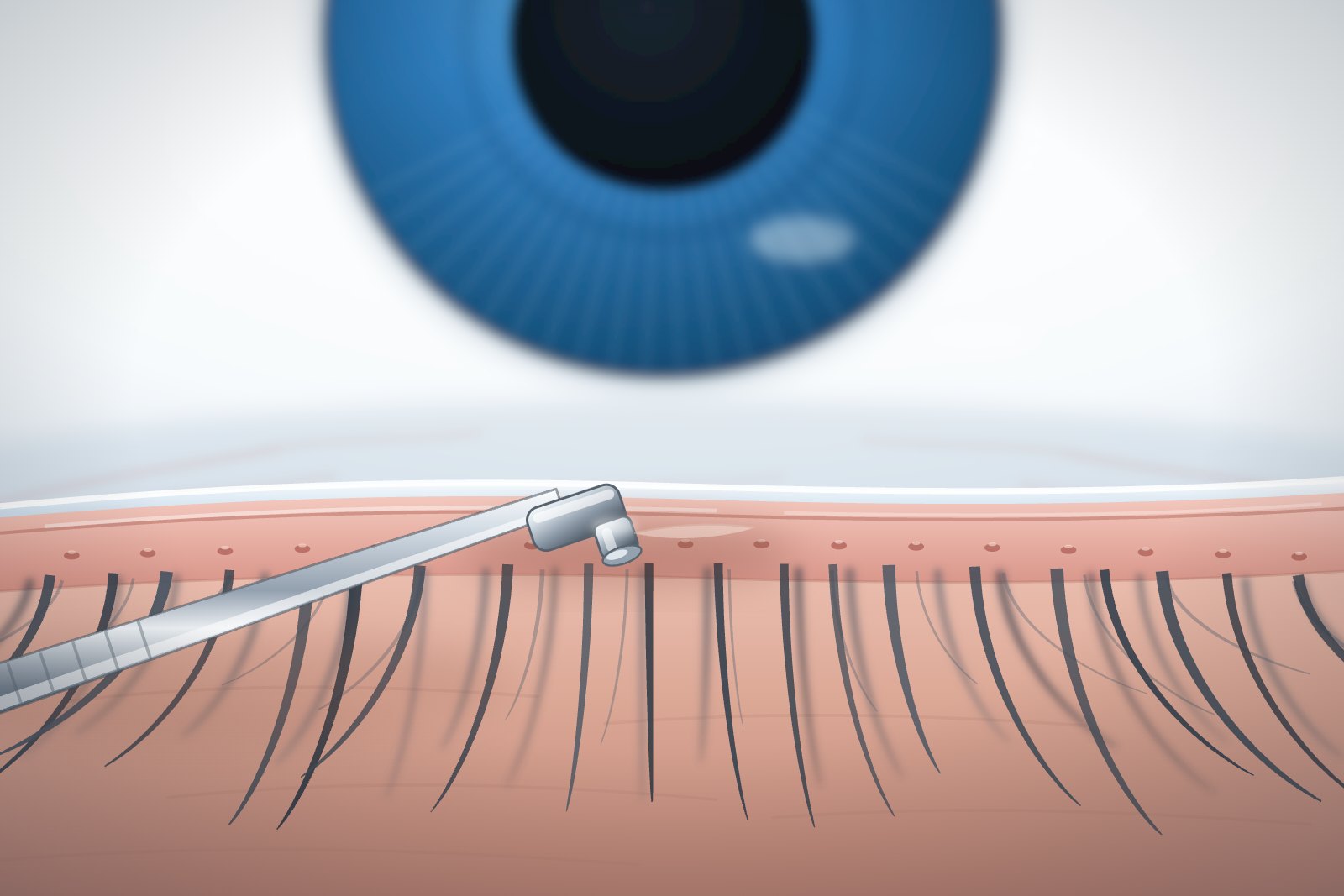
Ask most people what happens at a dry eye clinic and they will describe a machine. Devices matter — but a substantial part of dry eye care is done with the clinician's hands, a slit lamp and a set of unglamorous procedures that rarely make the marketing. They are often the difference between a device treatment working and a device treatment disappointing.
Lid debridement
Along the edge of your eyelid, just behind the lashes, sits a line of tiny openings — the exits of the meibomian glands. Over time, keratin and dead surface cells build up over that line, capping the openings like a skin over a paint tin.
Lid debridement is the removal of that excess keratin from the lid margin, performed in the practice at the slit lamp. It is quick, and its purpose is purely mechanical: clear the exits so the glands can discharge. Debridement improves the function of glands that are otherwise perfectly capable of working — which is why it is often the first thing done, before any question of heating or expressing.
It is closely related to, but distinct from, BlephEx microblepharoexfoliation, which uses a rotating micro-sponge to exfoliate the lash line and the biofilm around it. Debridement targets the gland openings; BlephEx targets the lash base and the bacterial layer. Many lids need both.
Meibomian gland expression
If debridement opens the exits, expression empties the glands. It is a procedure of around fifteen minutes in which the clinician applies firm, controlled pressure along the lid — usually with paddles or forceps designed for the purpose — to evacuate stagnant meibum from the glands behind.
Two things make it valuable. First, clearing the stagnant contents encourages the gland to resume producing normal oil rather than the thickened, toothpaste-like secretion that characterises obstructive disease. Second, it is diagnostic as well as therapeutic: what comes out — clear and free-flowing, cloudy, granular or nothing at all — tells your optometrist exactly how advanced the disease is, gland by gland.
Expression is uncomfortable, and no clinician will pretend otherwise. It is usually performed after the glands have been warmed, because cold meibum does not move. It is also frequently paired with IPL — the evidence for IPL is strongest when expression is performed alongside it — and it may be repeated at intervals of a fortnight, a month or longer depending on how quickly the glands re-obstruct.
Blephasteam and moist-heat therapy
Blocked meibum liquefies at around 40–42°C, and it needs that temperature held at the gland for several minutes. A face cloth cannot do it: it cools within a minute and heats only the outside of the lid.
Blephasteam is a moist-heat goggle worn in the practice for about ten to fifteen minutes. The latent moist heat penetrates more effectively than dry heat and melts meibomian secretions in a way that makes subsequent expression both more productive and more comfortable. It is not a competitor to LipiFlow, which heats from the inner lid surface and expresses simultaneously in one automated cycle — Blephasteam is the simpler, gentler preparation step, and it is often what makes manual expression tolerable.
Lacrimal lavage: for eyes that water
The other procedures address the oil. Lacrimal lavage addresses the plumbing.
Tears drain from the eye through the canaliculi — narrow channels at the inner corner of each lid — into the nose. These can become partially blocked, and when they do, tears overflow onto the cheek. The result is an eye that streams, which patients almost never associate with dry eye.
Lavage is a fifteen-minute in-office procedure in which sterile fluid is passed through the drainage channel to clear the obstruction. It is worth being precise about when it applies: most watery eyes are not a drainage problem at all — they are reflex tearing from a dry, unstable surface, and flushing the tear ducts of such an eye achieves nothing. A proper assessment separates the two before anyone reaches for a cannula.
How the procedures sequence
These are rarely standalone purchases. A typical staged plan reads something like: clear the lid margin first (debridement, exfoliation where there is biofilm or Demodex), warm the glands (Blephasteam or the heating phase of a device treatment), express what has been softened, then treat the inflammatory driver that caused the obstruction in the first place — IPL where there is a vascular and rosacea component, oral or topical anti-inflammatories where indicated.
Which links in that chain your eyes need is decided by measurement: gland imaging, tear-film analysis and what the glands actually yield when expressed. A plan that cannot say which link each step is fixing is not a plan.
Book an assessment
Every Dry Eye Specialist Group practice performs a structured lid and tear-film assessment before recommending any procedure. Find your nearest member practice or see all treatments.
References
- Jones L, Craig JP, Markoulli M, et al. TFOS DEWS III: Management and Therapy. American Journal of Ophthalmology. 2025;279:289-386.
- Korb DR, Blackie CA. Debridement-scaling: a new procedure that increases Meibomian gland function and reduces dry eye symptoms. Cornea. 2013;32(12):1554-1557.
- Nichols KK, Foulks GN, Bron AJ, et al. The International Workshop on Meibomian Gland Dysfunction: Executive Summary. Investigative Ophthalmology & Visual Science. 2011;52(4):1922-1929.
