
Rexon-Eye for dry eye: the electrotherapy option for stubborn, multifactorial dry eye
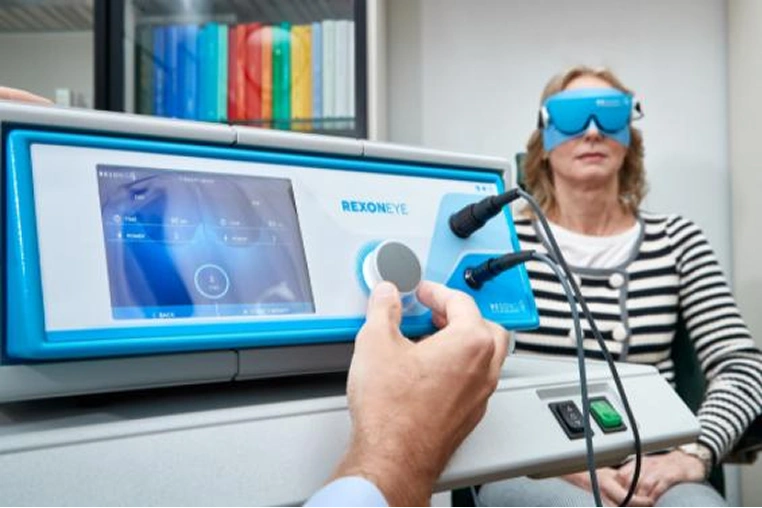
Most dry eye device treatments, including LipiFlow, IPL and Tixel, work by delivering heat to unblock the oil glands. Rexon-Eye takes a different route, which is what makes it worth understanding for people whose dry eye is mixed or has an inflammatory component and who have not been fully helped by heat-based treatment.
What Rexon-Eye does
Rexon-Eye uses low-power, high-frequency (4 to 64 MHz) alternating current, a technology called quantum molecular resonance (QMR). A mask with one electrode per eye rests on closed eyelids and delivers a painless electrical field to the lids and surrounding skin for 20 minutes, once a week for four weeks. The proposed mechanism is reduced inflammation and stimulation of the lid and surface tissues, rather than simply warming the glands.
The randomised, double-blind trial
The strongest evidence is a double-masked, placebo-controlled randomised trial of 40 patients, 20 per group, at a single academic centre in Israel (Shemer et al., Cornea, 2023). Adults with symptomatic dry eye received four weekly Rexon-Eye sessions or four identical sessions with the device set to zero power. Because the current is imperceptible and no display is visible to the patient, neither patients nor the examining ophthalmologists knew who had real treatment, the best protection against expectation shaping results. Everyone continued their usual dry eye drops, so the trial tested Rexon-Eye as an add-on to existing care, not a replacement for it. It was designed to detect a 5-point difference in OSDI symptom score: 14 people per group would give an 80% chance of finding one if real, and 20 per group were recruited.
- Symptoms (OSDI, 0 to 100), the main outcome: the treated group improved by 8.6 points on average (from 19.2 to 10.5) while the placebo group worsened by 0.5 (14.4 to 15.5). This between-group difference was significant (P = 0.002) and exceeded the trial's pre-set 5-point target.
- Meibomian gland score: improved by 0.75 with treatment versus worsening by 0.37 with placebo (between groups, P = 0.007).
- Corneal staining (surface damage): improved by 1.1 with treatment versus worsening by 0.3 with placebo (P = 0.044).
- Tear break-up time: rose 1.6 seconds with treatment and fell 0.45 seconds with placebo, but this did not reach statistical significance (P = 0.097), so it could be chance.
- Schirmer test (tear production) and vision: no difference between groups.
- No adverse events were reported in either group.
Note that the treated group started with somewhat worse symptoms (19.2 versus 14.4), a gap not statistically significant but one that leaves more room to improve. The trial reported between-group differences with P-values but no 95% confidence intervals, so precision is hard to judge.
Two uncontrolled studies in mixed-type dry eye
A Greek hospital series treated 51 patients (102 eyes) with dry eye from mixed causes: 27 with MGD, 18 with autoimmune-related surface disease such as Sjögren's, four after cataract surgery and two with glaucoma (Kavroulaki et al., Cureus, 2023). Symptom scores fell from 10.8 to 7.6 straight after the fourth session and 6.4 two months later (P < 0.001), and lipid-layer thickness by interferometry rose from 53.3 to 58.1 and then 59.8. Tear break-up time and gland loss did not change at end of treatment; two months later the changes were statistically significant but tiny (break-up time 7.50 to 7.59). Only 32 of the 51 patients (63%) returned for the two-month check, there was no comparison group, and the questionnaire appears to be a 0-to-28 SPEED-type scale rather than the 0-to-100 OSDI. No adverse events were recorded.
An Italian study treated 18 patients with medium-to-severe mixed-type dry eye using the same four-week protocol and examined them one month after the last session (Trivli et al., Journal of Optometry, 2023). It was prospective but non-randomised, with no control group. Symptoms improved (OSDI, P = 0.013), as did non-invasive break-up time (P < 0.001), corneal staining (P = 0.002), the number of expressible glands (P = 0.001), oil quality (P < 0.001) and the inflammatory marker MMP-9 in the tears (P = 0.003). Tear volume (meniscus height) and the Schirmer test did not change significantly, and gland structure on meibography was unchanged. No adverse events were reported. Only the abstract was available to us, so effect sizes cannot be quoted.
What the studies can't tell us
The controlled trial is small, 20 people per arm at a single centre, pooled every type of dry eye together, and did not report confidence intervals, so the size of the true effect is uncertain. It measured results only immediately after the fourth session, and because participants kept using their usual drops it shows what Rexon-Eye adds to standard care, not what it does alone. The two mixed-type studies had no sham or untreated group, which means they cannot separate the device from placebo, natural fluctuation or other treatment used at the same time, and one lost more than a third of participants before its final visit. None of the studies followed people beyond one to two months, so durability is unknown. None of the studies compared Rexon-Eye with LipiFlow, IPL or Tixel. And a point that matters for people with aqueous-deficient dry eye: across all three studies, measures of tear production (Schirmer, tear meniscus) did not improve. The measurable benefits so far are in symptoms, gland function, surface staining, lipid layer and inflammation, not in making more tears. No funding statements were available for the three papers.
Where it fits
Rexon-Eye is not usually the first thing to try for straightforward evaporative dry eye; heat-based treatment of the glands is better established for that. Its role is as an option for stubborn, mixed or inflammation-driven dry eye, or for people who have not had enough relief from other approaches, and the trial evidence supports it alongside, not instead of, your existing drops. The assessment comes first: treating the cause rather than the symptom means finding out which kind of dry eye you have, and dry eye remains a chronic condition that is managed, not cured.
Being assessed in New Zealand
Rexon-Eye is among the treatments available through the Dry Eye Specialist Group network. A full assessment measures your tear film and images your glands so your treatment is matched to your diagnosis. You can find your nearest clinic or call 0800 349 379. The Dry Eye Evaluation is a paid consultation. The New Zealand Eye Research Centre follows the evidence base for these newer treatments as it grows.
This article is general information and not a substitute for a clinical assessment. Whether Rexon-Eye suits you depends on an examination of your own eyes.
References
Sourced and verified via PubMed.
- Shemer A, Altarescu A, Nusbaum L, et al. Quantum Molecular Resonance Effects on Patients With Dry Eye Disease: A Randomized Controlled Trial. Cornea. 2023 (print 2024;43(9):1144-1149). PMID 38166187. https://doi.org/10.1097/ICO.0000000000003443
- Kavroulaki D, Konstantinidou E, Tsiogka A, Rallis K, Mavrikakis E. Quantum Molecular Resonance Electrical Stimulation as a Beneficial and Safe Treatment for Multifactorial Dry Eye Disease. Cureus. 2023;15(5):e39695. PMID 37398748. https://doi.org/10.7759/cureus.39695
- Trivli A, Karmiris E, Dalianis G, Ruggeri A, Terzidou C. Evaluating the efficacy of Quantum Molecular Resonance (QMR) electrotherapy in mixed-type dry eye patients. J Optom. 2023;16(2):128-134. PMID 35851496. https://doi.org/10.1016/j.optom.2022.06.003
