
IPL for dry eye: what the evidence shows about treating the cause
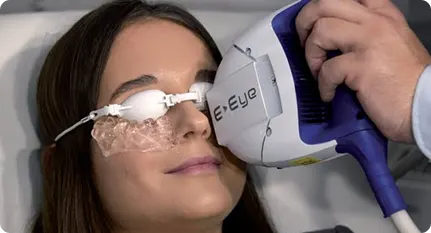
If you have worked your way through bottle after bottle of eye drops and your eyes are still dry, gritty and tired by the afternoon, you are probably treating the wrong thing. For most people, dry eye is not a shortage of water. It is a shortage of oil. Once you see that, intense pulsed light (IPL) and its evidence make sense.
Why most dry eye is really an oil problem
A healthy tear film has an oily top layer that slows evaporation. That oil comes from the meibomian glands along the eyelid margins. When they become blocked or inflamed, called meibomian gland dysfunction (MGD), tears evaporate too quickly and the eye surface dries out. This evaporative dry eye is by far the most common type. Drops add water but do nothing for the glands, which is why relief lasts minutes.
What IPL does, and how it is delivered
IPL is applied to the skin of the cheeks and below the lower lid margin, not to the eye itself, with your eyes covered. Pulses of filtered light warm the tissue and appear to calm the inflammation that drives MGD. In the best-designed trial it was given as four sessions two weeks apart, each followed by gentle gland expression to clear the softened oil.
What the strongest trial found
The key study is a sham-controlled, randomised trial across three US clinics (Toyos et al., PLOS ONE, 2022). Eighty-two adults with moderate-to-severe MGD completed it. Everyone had four sessions of gland expression; half also had real IPL and half had an identical set-up with the light blocked by a metal plate. Patients and the examiners were masked, though the person delivering IPL could not be. Outcomes were measured four weeks after the last session.
- Tear break-up time (how long the tear film stays stable) rose by 2.0 seconds with IPL versus 0.7 seconds with sham. The mean difference, which is simply the average gap between the two groups, was about 1.2 seconds in favour of IPL (P = 0.0076 after adjusting for starting values). 56% of IPL-treated eyes gained at least 3 seconds compared with 26% of sham-treated eyes.
- Gland function (a 0 to 45 score) improved by 18.5 points with IPL versus 5.2 with sham, a 13.3-point advantage. The number of working glands in the lower lid rose from about 11.5 to 20 with IPL, versus 10.6 to 12.3 with sham.
- Symptoms are the honest surprise. On the standard OSDI questionnaire both groups improved by about 26 points, and there was no difference between IPL and sham. Gland expression alone relieved symptoms substantially. On a separate eye-dryness scale IPL did give an extra 10.8-point improvement (P = 0.0072).
No serious adverse events occurred. Adverse events were recorded in 8.9% of the IPL group and 20.9% of the sham group; only one case of mild skin pain and one of bacterial conjunctivitis were judged possibly procedure-related. IPL is not painless: patients rated discomfort at about 50 out of 100 at the first session, falling to 41 by the fourth. Gland expression became less painful over the course in the IPL group. Sub-analyses were performed by the device sponsor, and the trial supported US regulatory approval of the device, so treat it as industry-linked.
A second trial: IPL with low-level light
A double-masked, sham-controlled trial from Bengaluru (D'Souza et al., Indian Journal of Ophthalmology, 2023) randomised 100 people with chronic MGD to three sessions of IPL plus a 15-minute low-level light mask, or sham, 15 days apart, with no gland expression in either group. Symptoms (OSDI) and tear break-up time improved significantly in the treated group at one and three months (P < 0.0001 and P < 0.005), with gains building between visits, while the sham group's improvement was not significant. Tear production (Schirmer test) did not change, as expected for an oil-layer treatment. No burns, pigmentation or complications were seen, and the highest pain score was 2 on a 0 to 10 scale. The catch: results are reported only as p-values and graphs, so exact effect sizes cannot be quoted, the comparison was within each group rather than directly between groups, and the study was funded by an educational grant from the device manufacturer.
What the studies can't tell us
Both trials followed people for only one to three months after the last session, so how long benefit lasts, and how often a top-up course is needed, is unknown. Neither could fully mask patients, because IPL is felt on the skin. In the Toyos trial six people dropped out, all from the IPL arm, and the sham group started with worse gland loss, which the analysis had to correct for. Both trials excluded darker skin types (Fitzpatrick V and VI). And because the symptom benefit over sham was modest or absent in the larger trial, expect IPL to improve the signs of MGD more reliably than it changes how the eyes feel. Dry eye is a chronic condition that is managed, not switched off, and results vary between people.
The step that has to come first: measurement
Not all dry eye is evaporative, and IPL is not right for everyone. A proper assessment measures your tear film and images your glands before anything is recommended.
Being assessed in New Zealand
The Dry Eye Specialist Group is a network of optometrists across New Zealand who assess and treat dry eye at this level, including IPL therapy. You can find your nearest clinic or call 0800 349 379. The Dry Eye Evaluation is a paid consultation. The New Zealand Eye Research Centre tracks the evolving evidence base for dry eye care.
This article is general information and not a substitute for a clinical assessment. Whether IPL suits you depends on an examination of your own eyes.
References
Sourced and verified via PubMed.
- Toyos R, Desai NR, Toyos M, Dell SJ. Intense pulsed light improves signs and symptoms of dry eye disease due to meibomian gland dysfunction: A randomized controlled study. PLoS One. 2022;17(6):e0270268. PMID 35737696. https://doi.org/10.1371/journal.pone.0270268
- D'Souza S, James E, Koul A, Modak D, Kundu G, Shetty R. A randomized controlled study evaluating outcomes of intense pulsed light and low-level light therapy for treating meibomian gland dysfunction and evaporative dry eye. Indian J Ophthalmol. 2023;71(4):1608-1612. PMID 37026310. https://doi.org/10.4103/IJO.IJO_2834_22
