
Why your eyelid hygiene routine works better with pictures
A note on sources: this article is based on the published abstract of the study. We were not able to access the full paper, so we have only used numbers reported in the abstract.
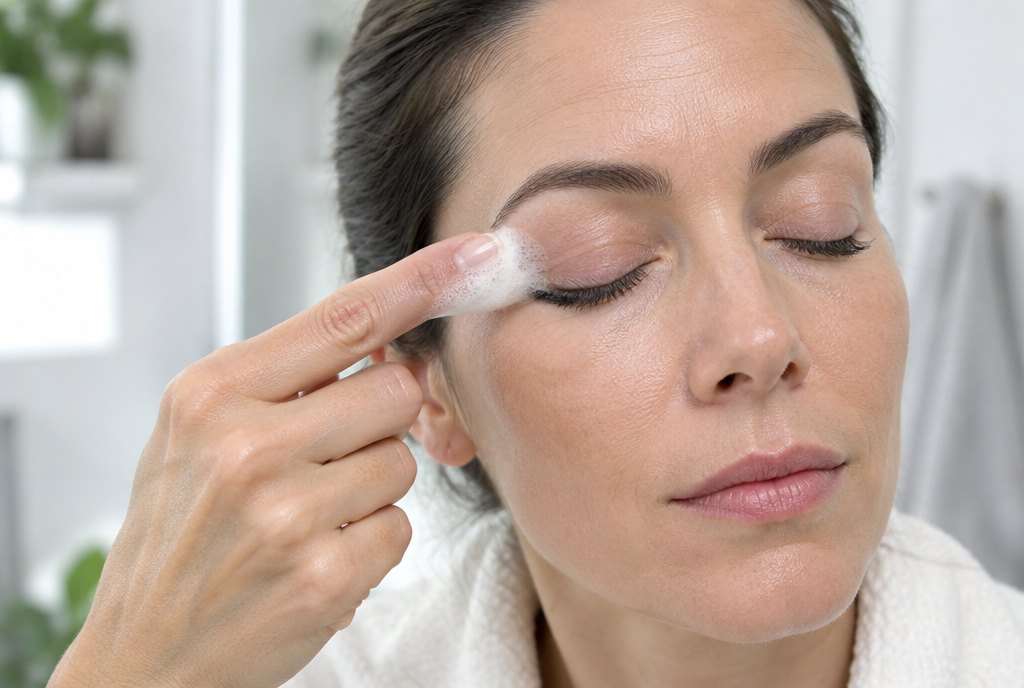
Daily eyelid hygiene, warming, gentle massage and cleaning the lid margin, is the foundation of managing meibomian gland dysfunction (MGD). It also only works if people actually do it. A randomised trial in International Ophthalmology (Ekicier Acar and Özdemir Yıldız, 2026) asked a simple question: does the way we explain the routine change whether people stick to it?
What the researchers did
114 people with MGD were randomly assigned to receive instructions for a home eyelid-hygiene routine in one of three ways:
- verbal instruction only;
- verbal instruction plus a written information sheet; or
- verbal instruction plus an illustrated, step-by-step guide.
The main outcome was whether people reported doing the routine fully at four weeks. The researchers also measured symptoms (OSDI), tear break-up time (FBUT), meibomian gland scores and tear production. 107 people (93.9%) completed follow-up.
What they found
Full adherence at four weeks was reported by:
- 60.0% of the verbal-only group (21 of 35)
- 80.6% of the written-sheet group (29 of 36)
- 86.1% of the illustrated-guide group (31 of 36)
The difference between the illustrated guide and verbal-only advice was 26.1 percentage points (95% CI 6.3 to 45.9). People given pictures had about four times the odds of sticking with the routine (adjusted odds ratio 3.96, 95% CI 1.20–13.05). The written sheet also helped, by 20.6 points, but that difference was not statistically significant (95% CI −0.2 to 41.3).
Symptoms improved in all three groups, by an average of 13.8 points on the OSDI, with no difference between them. But tear break-up time and gland expressibility improved more in the illustrated-guide group than in the other two groups.
What does the confidence interval tell us?
The 95% confidence interval is a range of plausible values for the true effect. For pictures vs verbal advice, it runs from about 6 to 46 percentage points: almost certainly a real benefit, though its exact size is uncertain. For the written sheet, the interval just crosses zero, so we can't be confident it helps more than verbal advice alone, though it may.
Why sticking with it is hard
Eyelid hygiene asks people to add several minutes of warming, massage and cleaning to their day, often for months, with improvements that come slowly. It is easy to forget a step, do it too briefly, or stop once symptoms ease. Clear instructions are therefore not a minor detail: in this trial, how the routine was explained made a measurable difference to tear stability and gland function, not just to whether people said they had done it.
Practical takeaways
- Ask for written, illustrated instructions, or take a photo of a demonstration, so you can follow along at home.
- Link the routine to something you already do daily, such as brushing your teeth.
- Expect gradual change. Gland function often improves over weeks to months.
- If you are struggling to keep it up, tell your optometrist; there may be simpler options or in-clinic treatments that reduce the daily workload.
Choosing the right warm compress can also help: see does the type of warm compress mask matter?
Treat the cause, not just the symptom
Most dry eye is evaporative, driven by meibomian gland dysfunction (MGD): the oil glands along the eyelid margins become blocked or produce thick oil, so tears evaporate too fast. Drops can soothe symptoms, but lasting improvement usually comes from treating the glands and the lid margin. A Dry Eye Evaluation, a paid consultation with a dry eye–focused optometrist, measures tear stability, gland function and gland structure so that treatment can be matched to what is actually going on. You can find a clinic near you through our member practices list.
What the study can't tell us
- Adherence was self-reported, which tends to overestimate how often people actually do a routine.
- Four weeks is short; we don't know whether people kept it up for months.
- Participants couldn't be masked to the type of instructions they received.
- We have only read the abstract, so we don't know exactly what the illustrated guide looked like.
Getting started
A home routine is the base, and some people also benefit from in-clinic treatments that target the glands directly, such as IPL therapy for dry eye. See all treatment options. In Hamilton, the optometrists at the Rose Optometry Dry Eye Clinic, including Jagrut and Jacqueline Rowe, will show you the routine step by step.
Reference
- Ekicier Acar S, Özdemir Yıldız Z. Short-term adherence to eyelid hygiene after verbal, written, or visual education in patients with meibomian gland dysfunction: a prospective, parallel-group, randomized comparative study. International Ophthalmology. 2026. PMID 43071002. doi:10.1007/s10792-026-04354-7. (Abstract only.)
