
Tea tree oil or an antibiotic drop? What a four-week trial found for blocked oil glands
If your oil glands are blocked and your eyes feel dry, should the lids be treated with a tea tree oil product or an antibiotic drop? A small randomised trial from Egypt, published in Contact Lens and Anterior Eye in 2026, compared the two directly over four weeks. The results favoured tea tree oil on most measures, but the trial is small and short.
One thing to say plainly at the start: we could only read the published abstract of this paper, not the full text. Everything below comes from that summary, and several important details could not be checked. We list them further down.
Why this question matters
Meibomian gland dysfunction (MGD) is the most common reason tears evaporate too quickly. Our earlier post on what meibomian gland dysfunction is covers the background. Treating the cause means working on the glands and lid margins, not only adding lubricating drops.
What the trial did
The researchers randomised 50 adults with dry eye disease linked to MGD into two equal groups. One group used a topical tea tree oil gel. The other used preservative-free azithromycin 1% eye drops, an antibiotic that is also thought to calm lid inflammation. Both groups used their treatment for 4 weeks, and both also used preservative-free lubricants.
Six participants were lost to follow-up, so 44 people completed the 4-week assessment. The team measured:
- tear break-up time (how many seconds the tear film stays intact after a blink)
- the Schirmer I test (how much tear fluid wets a paper strip, in millimetres)
- two symptom questionnaires, the Ocular Surface Disease Index (OSDI) and the Dry Eye-Related Quality of Life Score (DEQS)
- a clinical grade of meibomian gland dysfunction
- two inflammatory signalling molecules in tears, interleukin-8 (IL-8) and interleukin-17 (IL-17)
The trial was described as single-masked, meaning only one party (the abstract does not say which) was unaware of the treatment allocation.
What it found
Both groups improved. Every clinical measure was better after treatment than before, in the tea tree oil group and in the azithromycin group alike (P < 0.001).
The between-group comparison at week 4 favoured tea tree oil on most measures:
- Quality of life score (DEQS, lower is better): median 10 with tea tree oil versus 35 with azithromycin (P < 0.001)
- Tear break-up time: median 11 seconds versus 8 seconds (P < 0.001)
- Schirmer I test: mean 14 ± 2 mm versus 9 ± 2 mm (P < 0.001)
- Reaching MGD Grade 0: 63.6% versus 9.1% (P < 0.001)
- Tear IL-17: mean 27 ± 1 pg/mL versus 44 ± 1 pg/mL (P < 0.001)
It was not all one way. The reduction in IL-8 was more pronounced in the azithromycin group, which the authors read as the two treatments acting on different inflammatory pathways. The abstract gives no between-group figure for the OSDI symptom score.
A note on the statistics. A P-value is the probability of seeing a difference this large if the treatments were really equal; below 0.05 is the usual threshold for 'unlikely to be chance'. It does not tell you how lasting the benefit would be, and the abstract reports no confidence intervals, the ranges that show how precise each estimate is.
Signs, not just symptoms
A strength here is that the trial measured both how people felt and what could be seen and measured at the eye. Tear stability, gland grade and a symptom-related quality of life score moved in the same direction. The interleukin results are laboratory markers: they are not something you feel, and a four-week change does not show long-term benefit.
What the studies can't tell us
- We read the abstract only. We could not check the tea tree oil concentration or formulation, how and where the gel was applied, how often either treatment was used, baseline values, how many people dropped out of each group, adverse events, funding or conflicts of interest, the number of study sites, or the authors' own list of limitations.
- Small numbers. Fifty people were randomised and 6 of them did not finish. The abstract does not say whether their results were accounted for.
- Short follow-up. Four weeks is very brief for a long-term condition. This trial cannot say what happens at three, six or twelve months.
- Single masking. If participants or examiners knew which treatment was being used, questionnaire answers and clinician-graded measures such as MGD grade could be influenced.
- No placebo or untreated group. Everyone received an active treatment plus lubricants, so we cannot tell how much of the improvement in either group came from the lubricants, from better lid care habits, or from simply being in a study.
- One setting. All authors are based at Egyptian universities. Results may differ in other populations and climates, and with other products.
- Safety is not described in the abstract. That matters, because tea tree oil can irritate the eye surface.
A caution about tea tree oil
Please do not try to recreate this at home. Undiluted or home-mixed tea tree oil can injure the surface of the eye. Only purpose-made eyelid products should be used near the eyes, and the gel used in this trial is not necessarily the same as any product sold in New Zealand. Tea tree oil has mostly been studied for Demodex blepharitis.
It is also worth remembering that simpler lid hygiene has trial evidence of its own. Our post on the lid wipes, hypochlorous acid and saline trial looks at that question.
What this means for you in Hamilton
This trial adds a modest piece of evidence that a tea tree oil based lid treatment was associated with greater short-term improvement than an antibiotic drop in people with MGD. It does not show that tea tree oil suits everyone, that the effect lasts, or that an antibiotic is the wrong choice. Azithromycin drops are a prescription medicine, and whether any prescribed medicine for dry eye is available and suitable is something to discuss with your optometrist.
The useful first step is finding out what is driving your dry eye. The optometrist team at Rose Optometry in Hamilton assess this at the dry eye clinic, and you can see the range of dry eye treatments that may follow from that assessment. The optometrists at Rose Optometry are Anjali Hira, Emilie Lawson, Jacqueline Rowe, Jagrut Lallu, Jason Shen, Jessica Wood and Stella Wong, and dry eye care is part of their clinical practice.
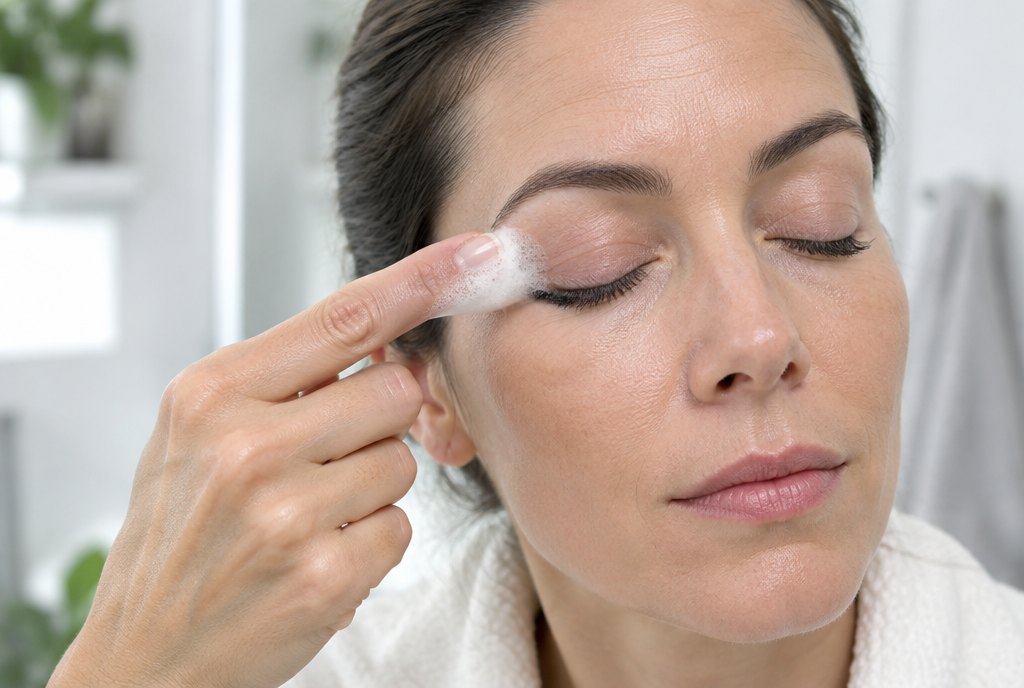
If your optometrist recommends a tea tree oil based lid cleanser, Blephadex eyelid foam cleanser is available from the Rose Optometry online store. It was not the product tested in this trial, and stinging or redness is a reason to stop and seek advice.
Rose Optometry is part of the Dry Eye Specialist Group, alongside Visique Rototuna Optometrists and other member practices. If you live outside Hamilton, your local Dry Eye Specialist Group member practice is the place to start.
Reference
- El-Afify DR, Mahmoud RHH, Kotkata FA, Abdelhalim TI, Saad EME. Evaluating the efficacy of topical tea tree oil versus preservative-free azithromycin in the treatment of dry eye disease associated with meibomian gland dysfunction: A randomized controlled trial focusing on tear interleukin levels. Contact Lens and Anterior Eye. 2026;49(6):102843. PMID 42764009. https://doi.org/10.1016/j.clae.2026.102843
