
Preservative-Free vs Preserved Eye Drops: Does the Preservative Matter?
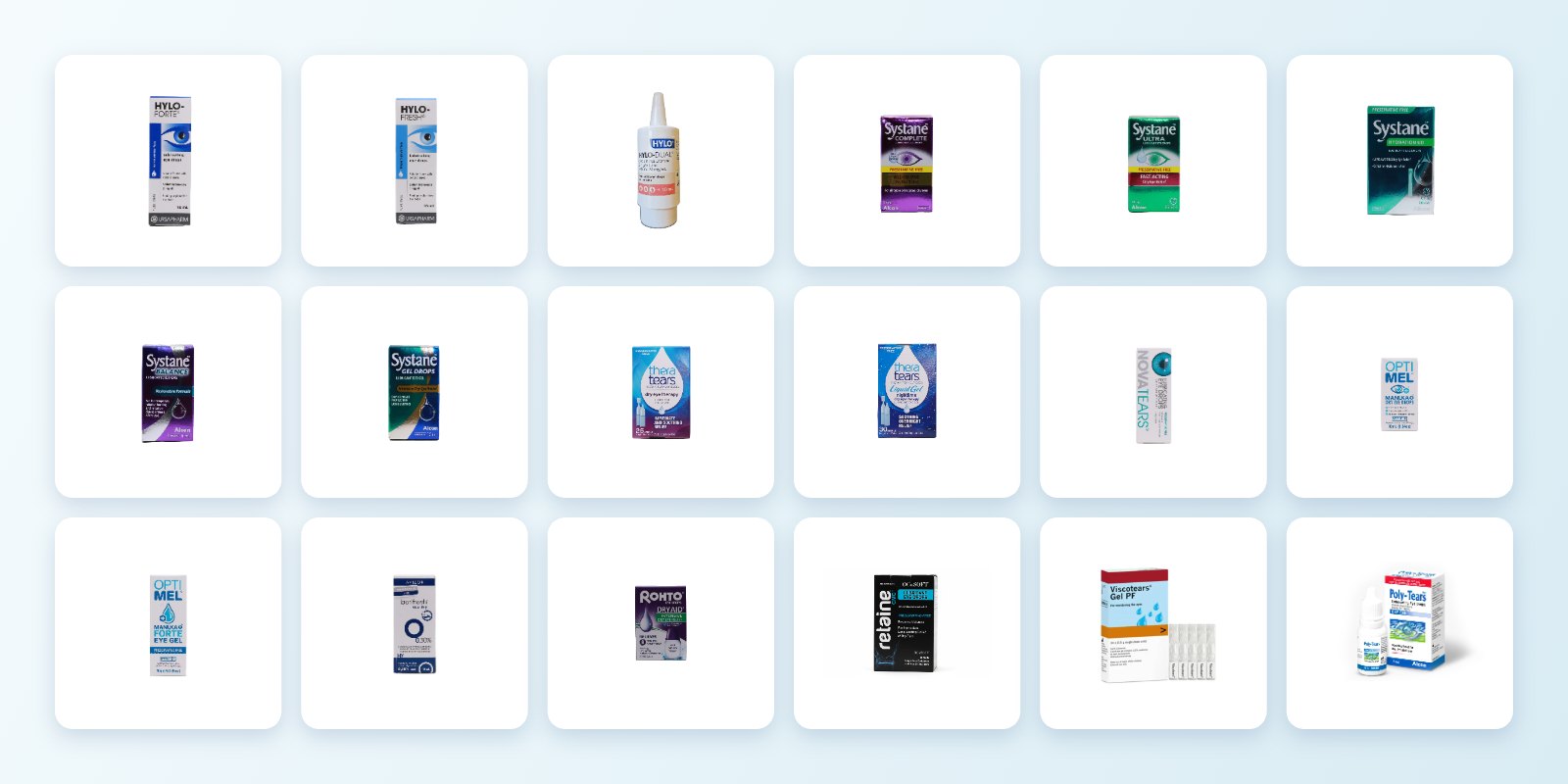
Most people with dry eye start with lubricating drops from the pharmacy shelf. Many of those bottles contain a preservative, most often benzalkonium chloride (BAK), which keeps a multi-use bottle free of germs once it has been opened. BAK is known to irritate the surface of the eye in laboratory and observational studies, but it has been surprisingly hard to show how much it matters in real patients, because preserved and preservative-free drops usually differ in other ingredients too.
A new randomised trial from Romania, published in Translational Vision Science & Technology, got around that problem neatly. It compared the same hyaluronic acid drop, from the same manufacturer, at the same strength – one version preserved with BAK in a multi-dose bottle, the other preservative-free in single-dose vials. The only intended difference was the preservative.
How the study was run
Researchers enrolled 47 adults with dry eye that had lasted more than three months, confirmed by standard international (TFOS DEWS II) criteria. Each person was randomly allocated to one of two drops containing 0.15% sodium hyaluronate:
- Preservative-free single-dose vials, or
- BAK-preserved multi-dose bottle (BAK 0.005%).
Participants used the drops in both eyes as often as they felt they needed to, for six months. They were checked at one, three and six months. The main outcome was the Ocular Surface Disease Index (OSDI), a 0–100 symptom questionnaire where lower is better and 0–12 counts as normal. The team also measured tear break-up time, tear production (Schirmer test), staining of the cornea and conjunctiva, vision and how many drops people used each day. Forty-three people (91.5%) completed the study: 22 on preservative-free drops and 21 on preserved drops.
What they found
Symptoms improved more without the preservative
Both groups felt better. After adjusting for starting scores and sex, OSDI fell by 14.36 points with the preservative-free drop (95% confidence interval −16.25 to −12.47) and by 9.42 points with the preserved drop (95% CI −11.36 to −7.49). The difference between the groups was statistically significant (P = 0.001). About 40% of people using the preservative-free drop had a normal OSDI score at six months, compared with none of those using the preserved drop.
A quick guide to those numbers: a 95% confidence interval is the range of values the true result most plausibly sits within, given the size of the study. A P-value estimates how likely a difference at least this large would be if the two drops truly performed the same; P = 0.001 means roughly a one-in-a-thousand chance, so chance alone is an unlikely explanation.
But the gap was modest
The between-group difference was about 5 points (5.24 points in the main analysis, 95% CI 0.83 to 9.64). The authors themselves note this is smaller than the 10-point difference they had set as the minimum clinically important change. In other words, the average extra benefit was real but not large; the more striking finding is how many more people reached a normal symptom score.
Signs did not differ at the final visit
Tear break-up time, Schirmer results, staining and vision all improved in both groups, and at six months there was no significant difference between the groups on any of these clinical signs. The pattern of change over time differed for some signs (staining and non-invasive break-up time), and break-up time actually improved numerically more in the preserved group by the end. Symptoms and signs also did not move together: changes in OSDI and tear break-up time were not correlated.
Fewer drops needed
People on the preservative-free drop used fewer drops a day at every visit, for example 2.68 ± 0.84 versus 3.52 ± 0.75 at six months. No adverse events were reported in either group.
What this means for you
If you use lubricating drops several times a day, every day, this trial adds reasonable support for choosing a preservative-free option. It does not show that preserved drops damage the eye over six months – the clinical signs ended up similar – but people felt better on the preservative-free version and needed it less often.
It is also a reminder that drops mainly manage symptoms. In most people, dry eye is driven by an underlying cause such as blocked oil glands (meibomian gland dysfunction), eyelid inflammation or incomplete blinking. Our dry eye drop formulary based on DEWS III explains how to match drop types to the problem, and our article on modifiable dry eye risk factors and MGD covers what drives the condition. If drops alone are not enough, the dry eye treatments page outlines in-clinic options that target the cause.
What the studies can't tell us
- Only single-masked. The person measuring outcomes did not know the allocation, but patients could see whether they had vials or a bottle. Because the main outcome is a symptom questionnaire, expectations may have played a part.
- Small sample. 43 completers is enough to detect a symptom difference, but not to rule out smaller differences in signs.
- Per-protocol analysis. Four people who missed the final visit were left out of the main analysis, although a sensitivity analysis including everyone gave a similar result (5.66 points, 95% CI 1.42 to 9.90).
- Unbalanced groups. 55% of the preservative-free group were men versus 19% of the preserved group; the authors adjusted for this but could not fully explore it.
- Flexible dosing. People used drops as needed, so exposure to BAK varied.
- One product and six months. Results may not apply to other preservatives, other concentrations, or many years of use.
- Funding. The paper does not report a funding source; all authors declared no conflicts of interest.
Getting your dry eye assessed
Choosing a drop is easier when you know what is driving your dry eye. The aim is to treat the cause, not just the symptom. The first step is a full eye examination (or a copy of one done elsewhere within the last six months), followed by a Dry Eye Evaluation, which is a paid consultation. Any in-clinic treatment is then recommended from what the examination and Evaluation find, rather than chosen in advance.
Dry Eye Specialist Group member practices
The Dry Eye Specialist Group is a group of independent optometry and ophthalmology practices across New Zealand that share a diagnosis-first approach.
- Illume Eye Care, Ponsonby, Auckland — 09 280 3711 — illumeeyecare.co.nz
- Bay Eye Care, Tauranga — 07 571 6644 — bayeyecare.co.nz
- Rose Optometry, Hamilton — 07 847 3195 — roseoptom.co.nz
- Visique Rototuna Optometrists, Rototuna, Hamilton — 07 852 5625 — rototunaoptometrists.co.nz
- Eye Surgeons, Hamilton, Cambridge, Pukekohe, Thames and Whanganui — 07 242 0977 — eyesurgeons.co.nz
- Visique Shattky Optometrists, Hastings and Waipukurau — Hastings 06 876 3777, Waipukurau 06 858 9117 — shattky.co.nz
- Feilding Visique Optometry, Feilding — 06 323 9067 — feildingvisique.co.nz
- Naylor Palmer Optometrists, Palmerston North — 06 358 8781 — naylorpalmer.co.nz
- Milburn & Neill Optometrists, Dunedin — 03 477 7666 — milburnandneill.co.nz
Not every treatment is offered at every practice. For more detail, see the Dry Eye Specialist Group member practices page or call the Dry Eye Specialist Group on 0800 349 379.
References
- Bucsan R, et al. Randomized Single-Masked Study of Preservative-Free Versus Preserved Hyaluronic Acid in Dry Eye Disease. Translational Vision Science & Technology. 2026. PMID 42986170. doi:10.1167/tvst.15.11.6
