
Light Therapy for Dry Eye in Thyroid Eye Disease: A Sham-Controlled Trial
Thyroid eye disease (also called Graves' orbitopathy) is an autoimmune condition that can push the eyes forward, pull the eyelids back and inflame the tissues around the eye. Dry eye is one of its most common complications, reported in 60–80% of people with the condition, and it is often stubborn: wider-open eyes evaporate tears faster, and the ongoing inflammation keeps re-injuring the eye surface.
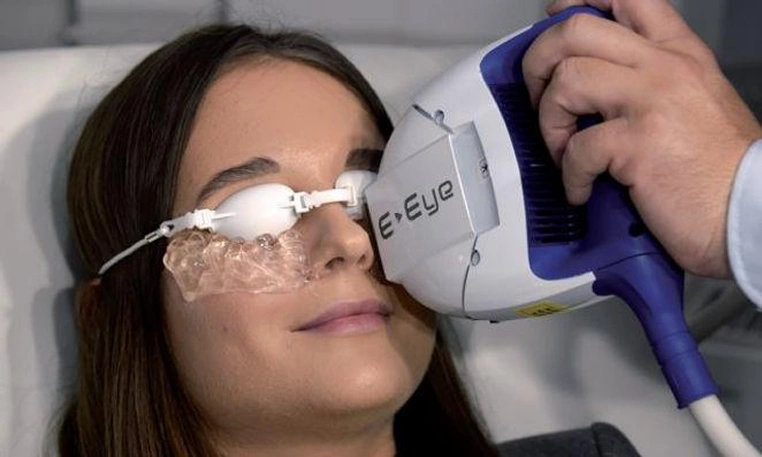
Low-level light therapy (LLLT), also called photobiomodulation, uses a mask of red LED light over closed eyelids. We have previously summarised the general evidence for low-level light therapy in dry eye, so this article focuses only on one new trial in a specific group: people with thyroid eye disease whose dry eye had not settled despite intensive standard care.
How the study was run
The trial, from two centres in Romania and published in the International Journal of Molecular Sciences, was randomised, sham-controlled and double-masked (patients and the person measuring outcomes did not know who received what; the operator delivering treatment did). Key features:
- Who: adults with mild-to-moderate thyroid eye disease and dry eye that was still symptomatic after at least a month of preservative-free drops and gel six times a day, a bedtime ointment and daily lid hygiene. That routine continued unchanged in both groups.
- Allocation: 51 people were randomised 2:1, so twice as many received active treatment. After five dropped out without follow-up data, 46 were analysed: 30 active and 16 sham. One eye per person was analysed.
- Treatment: a 630 nm red LED mask, 15 minutes once a week for four sessions.
- Sham: the same mask and routine, but with the light output reduced to less than 30% of the treatment level – not switched off. The authors acknowledge they cannot prove this lower dose was completely inactive.
- Follow-up: weekly during treatment, then one and two months after the last session.
The main outcome was the OSDI symptom questionnaire (0–100, lower is better), measured at the end of treatment. Other measures included tear osmolarity (how “salty” the tears are, which rises in dry eye), tear break-up time, tear production, oil-gland imaging and corneal staining.
What they found
Symptoms
At the end of the four sessions, OSDI was lower with active light than sham by 7.49 points (95% confidence interval −11.66 to −3.32; P < 0.001). The authors note this was just under the 8-point difference they had planned as clinically meaningful. The gap widened after treatment stopped: 11.97 points at one month (95% CI −16.44 to −7.50) and 16.86 points at two months (95% CI −21.51 to −12.21). Sham-group scores stayed fairly flat.
Tears and the eye surface
Tear osmolarity fell more with active treatment: by 10.91 mOsm/L at one month (95% CI −18.96 to −2.87; P = 0.009) and 13.81 mOsm/L at two months (95% CI −22.55 to −5.06; P = 0.004). However, there was no demonstrated difference in tear break-up time, tear production, oil-gland imaging or the tear lipid layer. Corneal staining trended lower with active light (15.7% vs 34.7% of eyes at one month) but this was not statistically significant (P = 0.100).
Safety
No treatment-related adverse events were recorded. One person with very prominent eyes felt extra warmth and used a spacer for comfort.
Making sense of the statistics
A 95% confidence interval is the range in which the true difference most plausibly lies; when the whole range sits below zero, as with the symptom results, the benefit is unlikely to be zero. A P-value estimates the chance of seeing a difference this large if the treatment had no real effect. P = 0.100 for staining means the data are compatible with no difference.
What this means for you
For people with thyroid eye disease, this is encouraging but early evidence that a short course of light therapy may ease symptoms and reduce tear saltiness when standard drops and lid care are not enough. It did not change tear stability or the oil glands within two months, and it does not treat the thyroid eye disease itself – the authors position it as an add-on, alongside care from your endocrinologist and eye specialist. An exploratory analysis suggested a bigger symptom benefit in people with active inflammation, but that subgroup included only six sham eyes, so it needs confirming.
Light therapy is one of several options. Our summary of a network meta-analysis of 47 dry eye device trials shows where different treatments sit, and the dry eye treatments page explains what is available.
What the studies can't tell us
- Small and unequal groups. Only 16 people received sham, which limits precision.
- Not a true placebo. The sham still emitted reduced light.
- Short follow-up. Two months after the last session; benefits were still growing, so we don't know how long they last or when retreatment is needed.
- Symptom-led result. The main outcome is a questionnaire, which is more open to expectation effects, and by two months only 36 of 46 questionnaires were complete enough to analyse.
- Registration differences. The trial registry listed tear break-up time as the primary outcome, while the paper used OSDI as specified in the ethics-approved protocol; the authors disclose this.
- Narrow group. One country, mostly women, mild-to-moderate disease only.
- Funding. The study was funded by a Romanian public health research programme and the authors declared no conflicts of interest.
Getting your dry eye assessed
Dry eye with thyroid eye disease usually has several causes at once, so it pays to have each one assessed. The aim is to treat the cause, not just the symptom. The first step is a full eye examination (or a copy of one done elsewhere within the last six months), followed by a Dry Eye Evaluation, which is a paid consultation. Any in-clinic treatment is then recommended from what the examination and Evaluation find, rather than chosen in advance.
Dry Eye Specialist Group member practices
The Dry Eye Specialist Group is a group of independent optometry and ophthalmology practices across New Zealand that share a diagnosis-first approach.
- Illume Eye Care, Ponsonby, Auckland — 09 280 3711 — illumeeyecare.co.nz
- Bay Eye Care, Tauranga — 07 571 6644 — bayeyecare.co.nz
- Rose Optometry, Hamilton — 07 847 3195 — roseoptom.co.nz
- Visique Rototuna Optometrists, Rototuna, Hamilton — 07 852 5625 — rototunaoptometrists.co.nz
- Eye Surgeons, Hamilton, Cambridge, Pukekohe, Thames and Whanganui — 07 242 0977 — eyesurgeons.co.nz
- Visique Shattky Optometrists, Hastings and Waipukurau — Hastings 06 876 3777, Waipukurau 06 858 9117 — shattky.co.nz
- Feilding Visique Optometry, Feilding — 06 323 9067 — feildingvisique.co.nz
- Naylor Palmer Optometrists, Palmerston North — 06 358 8781 — naylorpalmer.co.nz
- Milburn & Neill Optometrists, Dunedin — 03 477 7666 — milburnandneill.co.nz
Not every treatment is offered at every practice. For more detail, see the Dry Eye Specialist Group member practices page or call the Dry Eye Specialist Group on 0800 349 379.
References
- Timofte-Zorila MM, et al. Low-Level Light Therapy for Dry Eye Disease in Thyroid Eye Disease: A Randomized, Double-Masked, Sham-Controlled Trial. International Journal of Molecular Sciences. 2026. PMID 43028050. doi:10.3390/ijms27219802
